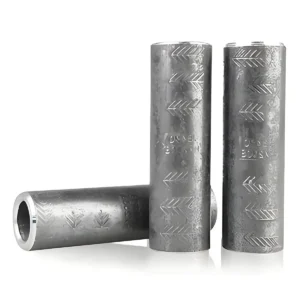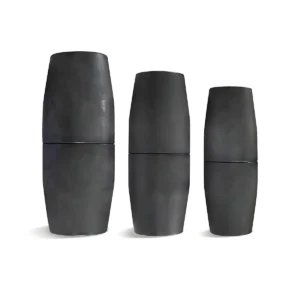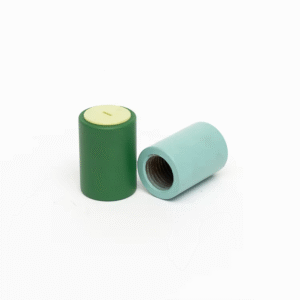

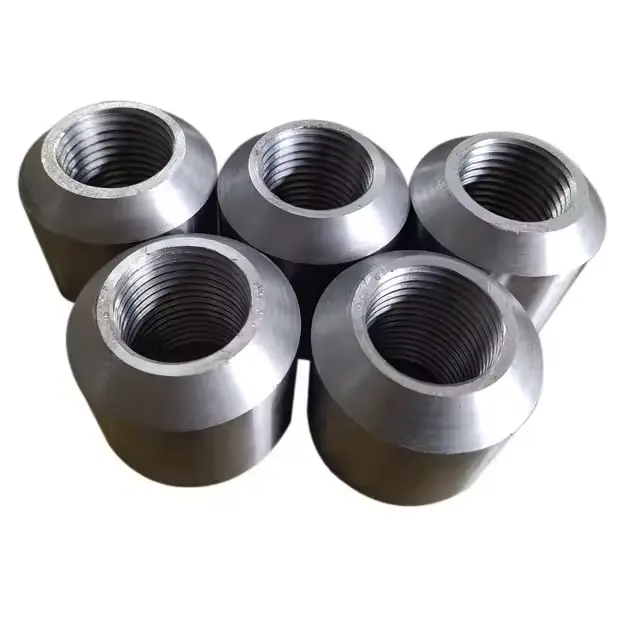
Weldable Rebar Couplers
• Essential Solution: The necessary method for connecting rebar to steel structures.
• Flexible Positioning: Allows for adjustment during installation; good tolerance accommodation.
• Compact Connection: Saves space.
Description
Weldable rebar couplers (also known as weld sleeves or rebar welding connectors) are embedded components specifically designed to achieve high-strength, highly reliable connections between steel structures and concrete structures. By threading one end to the rebar and welding the other end to the steel structure (such as steel columns, beams, or embedded plates), they effectively resolve the issue of force transfer between dissimilar materials. This product serves as a critical connection element for “steel-concrete composite structures,” finding extensive application in prefabricated buildings, bridges, industrial plants, and large public structures.
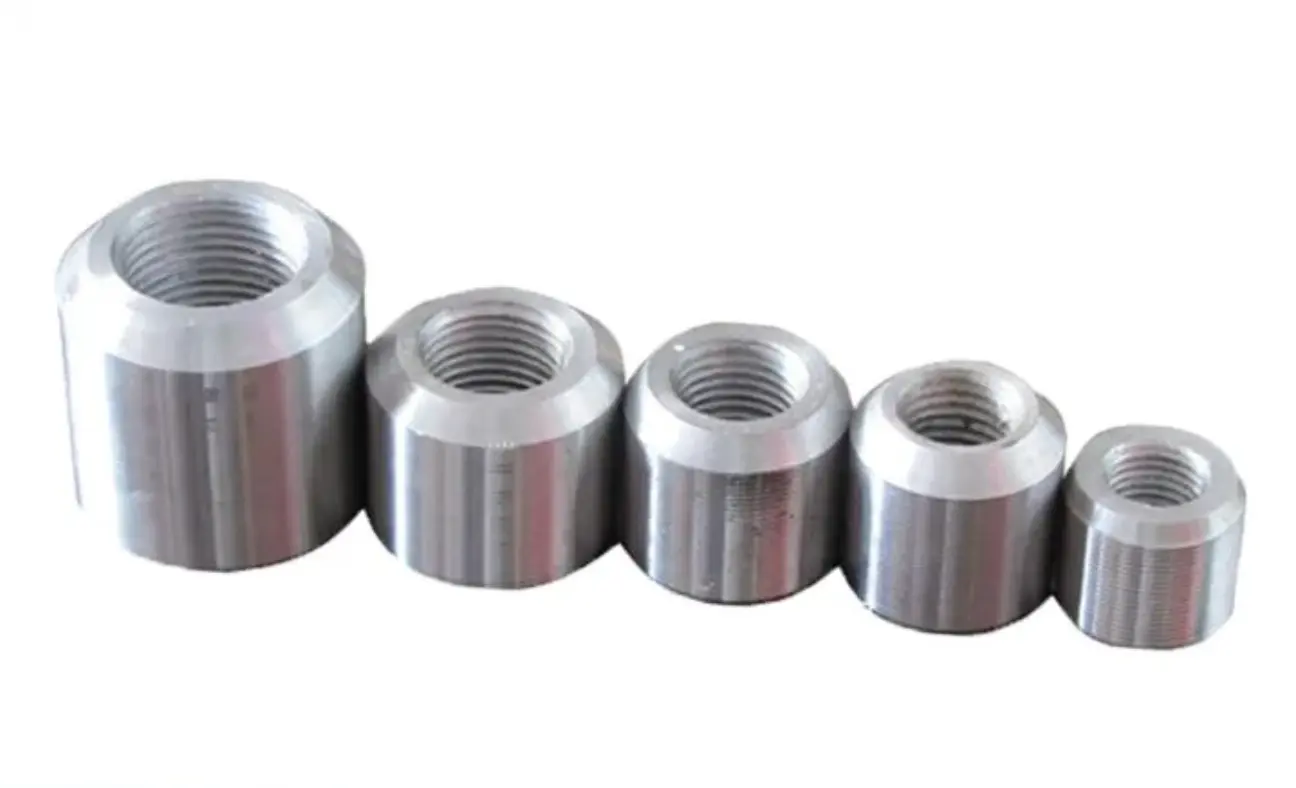
Weldable Rebar Couplers Specification
| Size | Outer Dia (mm) | Thread Angle | Length (mm) | Inner Dia (mm) | Thread Pitch |
| D12 | 19 | 60 | 28 | 10.28 | 1.75 |
| D14 | 21 | 75 | 32 | 12.55 | 2.5 |
| D16 | 24 | 75 | 36 | 14.5 | 2.5 |
| D18 | 27 | 75 | 41 | 16.35 | 2.5 |
| D20 | 30 | 75 | 45 | 18.45 | 2.5 |
| D22 | 32.5 | 75 | 49 | 20.35 | 2.5 |
| D25 | 37 | 75 | 56 | 23.25 | 3 |
| D28 | 41.5 | 75 | 62 | 25.95 | 3 |
| D32 | 47.5 | 75 | 70 | 30.15 | 3 |
| D36 | 53 | 75 | 78 | 33.85 | 3 |
| D40 | 58.5 | 75 | 86 | 37.55 | 3 |
Product Advantage
- Dual Connection, Reliable Load Transfer: Combines the convenience of threaded connections with the high strength of welded connections, ensuring efficient and stable load transfer from reinforcing bars to steel structures.
- High Strength and Ductility: Manufactured from premium carbon structural steel or alloy steel, it exhibits outstanding mechanical properties. Its tensile strength typically reaches 500MPa, 600MPa, or even higher, matching or exceeding the strength of the connected reinforcing bars to prevent brittle failure at connection nodes.
- Superior Weldability: The sleeve’s welded ends feature specialized design and treatment (e.g., beveled edges), ensuring excellent compatibility with various structural steels (e.g., Q235B, Q355B). Common welding techniques like arc welding and gas shielded welding can be employed, yielding stable and reliable weld quality.
- Flexible Construction with Controllable Precision:
1、Sleeves can be prefabricated with reinforcing bars at the factory before on-site welding to steel structures, enhancing construction efficiency and quality.
2、Alternatively, sleeves can be welded to steel structures first, followed by on-site tightening of reinforcing bars, accommodating diverse construction sequences. - Space-saving: Compared to traditional lap plates or hook connections, sleeve connections offer a more compact solution, particularly suitable for densely reinforced or spatially constrained nodes.
- Quality inspection ease: Threaded connections can be verified using torque wrenches, while welded connections can be tested via non-destructive methods (e.g., ultrasonic, magnetic particle inspection), supported by mature quality control measures.
Product Principle
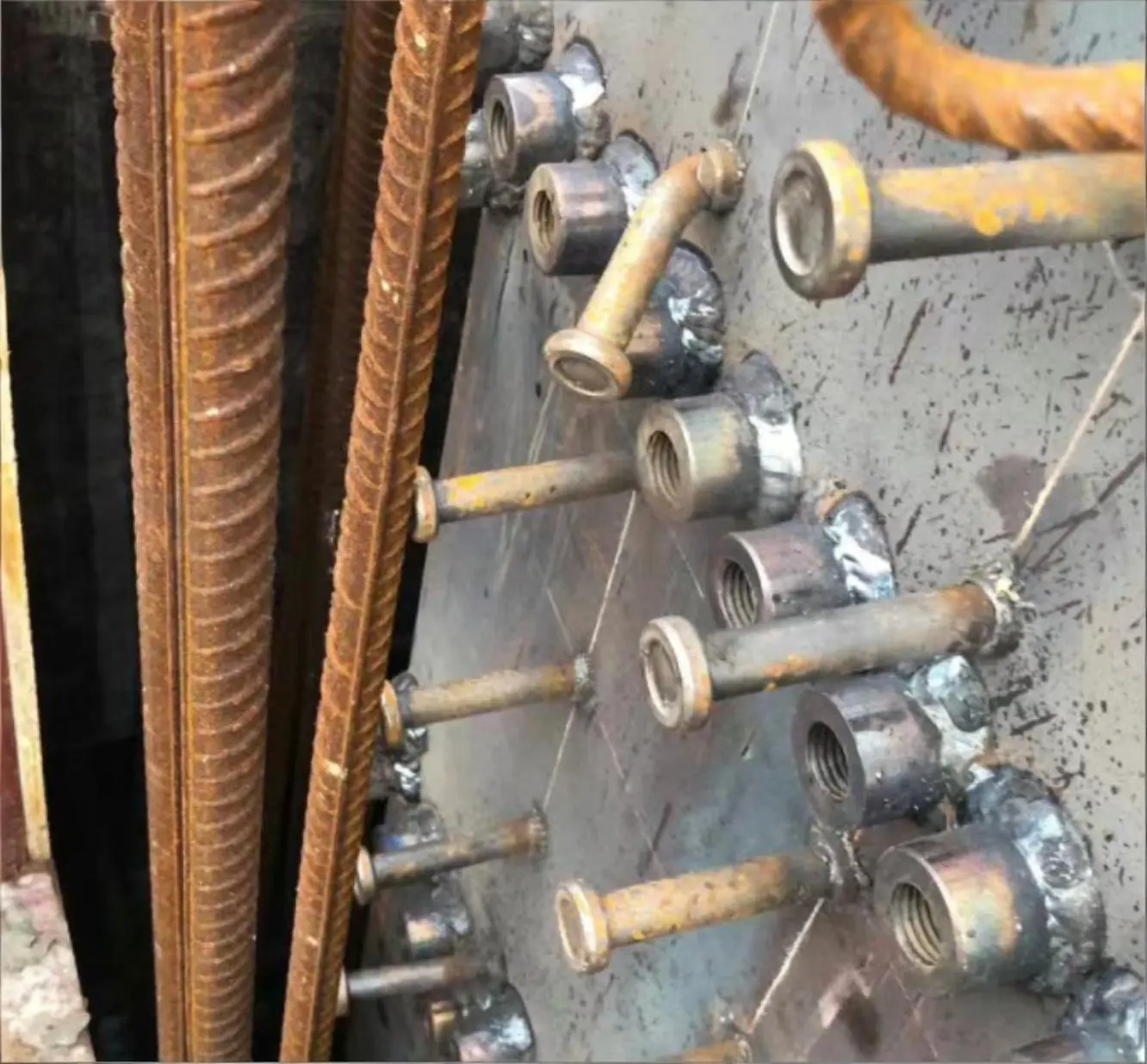
Weldable rebar couplers connections are primarily used to join reinforced steel columns (or structural steel columns) with frame beam rebars, achieving an efficient and reliable load-transferring connection between the two. The process relies on a specialized weldable rebar sleeve that serves a dual function:
- Welded end: Capable of being securely welded to the surface of the structural steel column.
- Threaded End: Features precision internal threads that mate with externally rolled threads on rebar ends.
During construction, loads are transferred through both the threaded engagement and the welded joint, achieving an equal-strength connection between the rebars.
Welding Procedure for Weldable rebar Couplers
- 1. Transport the weldability sleeves, which have been designed and tested for qualification, to the construction site or fabrication facility;
- Use specific fixtures or other auxiliary tools to determine the welding position;
- Remove the plastic protective cap from the sleeve;
- Position the large chamfered end of the weldable sleeve facing the steel beam (column) and perform two symmetrical spot welds. During spot welding, ensure a gap of approximately 2mm between the sleeve and steel column using jigs or other methods;
- Perform circumferential welding along the chamfer of the weldable sleeve to meet specified weld requirements;
- Conduct quality inspection of the welds;
Requirements for the Appearance Quality of Welds
- To ensure welding quality and joint integrity, weld appearance on the weldable sleeve must meet strict requirements:No porosity, slag inclusions, cracks, crater defects, or weld spatter shall be present. Any defects discovered must be promptly repaired by rewelding;
- The weld bead profile shall be uniform, full, and smoothly transitioned. Within any 25mm length of the weld, the surface height variation shall not exceed 2mm;
- The weld fillet dimensions shall comply with specifications, with a tolerance of 0-3mm.
Visual Inspection Method for Joint Appearance Quality
Specific visual inspection methods for welded sleeves after soldering completion:
- Tap the weld seam with a small metal hammer to check for defects such as porosity, slag inclusions, cracks, crater defects, or weld spatter. Any defects found must be promptly repaired by rewelding.
- Use calipers to measure whether the weld height meets specifications. Visually inspect whether the weld is fully formed without any underfills. The weld profile should be uniform, and the weld transition must be smooth.
Weldable rebar couplers vs. Straight Thread Sleeve Comparison
| Aspect | Weldable Sleeve | Straight Threaded rebar coupler |
| Core Definition | A coupler with one end weldable to steel structures and the other end featuring internal threads, enabling a steel-to-concrete cross-connection. | A coupler with internal threads on both ends, used for rebar-to-rebar connections of the same material. |
| Connection Objects | Rebar to Steel Structure (e.g., steel columns, beams, embed plates). | Rebar to Rebar. |
| Primary Applications | • Steel-reinforced composite structures (SRC columns/beams) • Prefabricated buildings (precast elements to steel nodes) • Bridge bearings • Equipment foundation embedments | • Splicing rebar in reinforced concrete structures • Connecting pile foundation reinforcement cages • Beam-column rebar connections • Any scenario requiring rebar lengthening |
| Connection Principle | Welding + Threads: The sleeve is welded to the steel structure, and the rebar is screwed into the sleeve. | Pure Threaded Connection: Two rebars with rolled threads are screwed into opposite ends of the coupler. |
| Load Path | Load transfers from the rebar to the steel structure primarily through the weld. | Load transfers from one rebar to the other through thread engagement within the coupler. |
| Installation Process | 1. Position and weld the sleeve to the steel structure. 2. Screw the rebar into the sleeve. | 1. Pre-assemble the sleeve onto one rebar. 2. Screw the other rebar into the opposite end to complete the connection. |
| Advantages | • Essential Solution: The necessary method for connecting rebar to steel structures. • Flexible Positioning: Allows for adjustment during installation; good tolerance accommodation. • Compact Connection: Saves space. | • Fast installation, high efficiency. • Consistent & Reliable Quality: Unaffected by weather or welder skill. • No open flame/arc: Safer, suitable for hazardous environments. • Can be pre-assembled. |
| Disadvantages/Limitations | • Dependent on Weld Quality: Requires skilled welders and strict procedures. • Heat-Affected Zone (HAZ): Welding heat can potentially alter material properties. • Slower Installation: Additional steps for welding and inspection. • Requires hot work permits, posing safety risks. | • Cannot directly connect to steel structures. • High requirement for rebar thread accuracy and tightening torque. • Requires sufficient workspace for wrench operation. |
| Cost Considerations | Higher unit cost for the sleeve itself, plus integrated costs of welding (labor, equipment, inspection). | Lower unit cost for the sleeve, but includes the cost of rebar thread rolling. Overall installation cost is often more economical. |
Rebar Coupler Selection Guide
Fundamental Difference: Their application domains are inherently different. The Weldable Sleeve is a “Translator”, facilitating communication (load transfer) between the world of steel structures and the world of concrete reinforcement. The Straight Threaded Sleeve is a “Connector”, used to extend communication within the same world (the rebar network).
Selection Advice:
- When connecting rebar to a steel structure (e.g., steel column, beam), you must use a Weldable Sleeve. It is the only correct choice.
- When splicing two rebars end-to-end, the Straight Threaded Sleeve should be the preferred choice. It is the mainstream, efficient mechanical splicing method.